
Designing with noise: embracing stochasticity in mechanical engineering

In the pursuit of precision, mechanical engineering often relies on deterministic models. However, the physical world is rarely defined by perfect Euclidean geometries. From the microscopic grain of a forged alloy to the turbulent airflow over a turbine blade, irregularity is a fundamental constant. This is where Stochastic Mechanics becomes essential, and where an unlikely tool from the world of computer graphics—Perlin Noise—provides a robust framework for modeling reality.
Beyond Randomness: Understanding Perlin Noise
Developed by Ken Perlin in 1983 to overcome the "machine-like" appearance of computer-generated surfaces, Perlin Noise is a type of gradient noise that produces a naturally ordered, smooth sequence of pseudo-random values. Unlike "white noise," where each value has no correlation with its neighbor, Perlin Noise provides a continuous derivative, mimicking the organic transitions found in nature.
Applications in Mechanical Product Development
In mechanical design, the "ideal" model is often a simplification. To move toward high-fidelity digital twins, we must integrate stochastic variables into our simulations:
- Surface Topology and Tribology: Real-world contact surfaces exhibit roughness that significantly impacts friction and wear. By applying Perlin-based heightmaps, we can simulate realistic surface textures to study lubrication behavior and micro-contact mechanics.
- Material Heterogeneity: Advanced composites and 3D-printed lattices often possess non-uniform density. Using Perlin noise allows engineers to model spatial variations in material properties (such as Young’s modulus), providing a more accurate prediction of stress distribution and failure points.
- Stochastic Fluid Dynamics: While Computational Fluid Dynamics (CFD) handles laminar and turbulent flows, Perlin noise can be used to generate initial velocity perturbations or to model atmospheric turbulence in aerospace applications, facilitating more resilient control system designs.
From Logic to Aesthetic: The Visual Identity of Ekio
The synergy between mathematical logic and mechanical reality is reflected in the very fabric of the Ekio website's illustrations. The procedural patterns gracing our website’s backgrounds—ranging from Flow Fields (simulating vector flux) to Wood Grain permutations and Topographic Waves—are direct outputs of the algorithms discussed above.
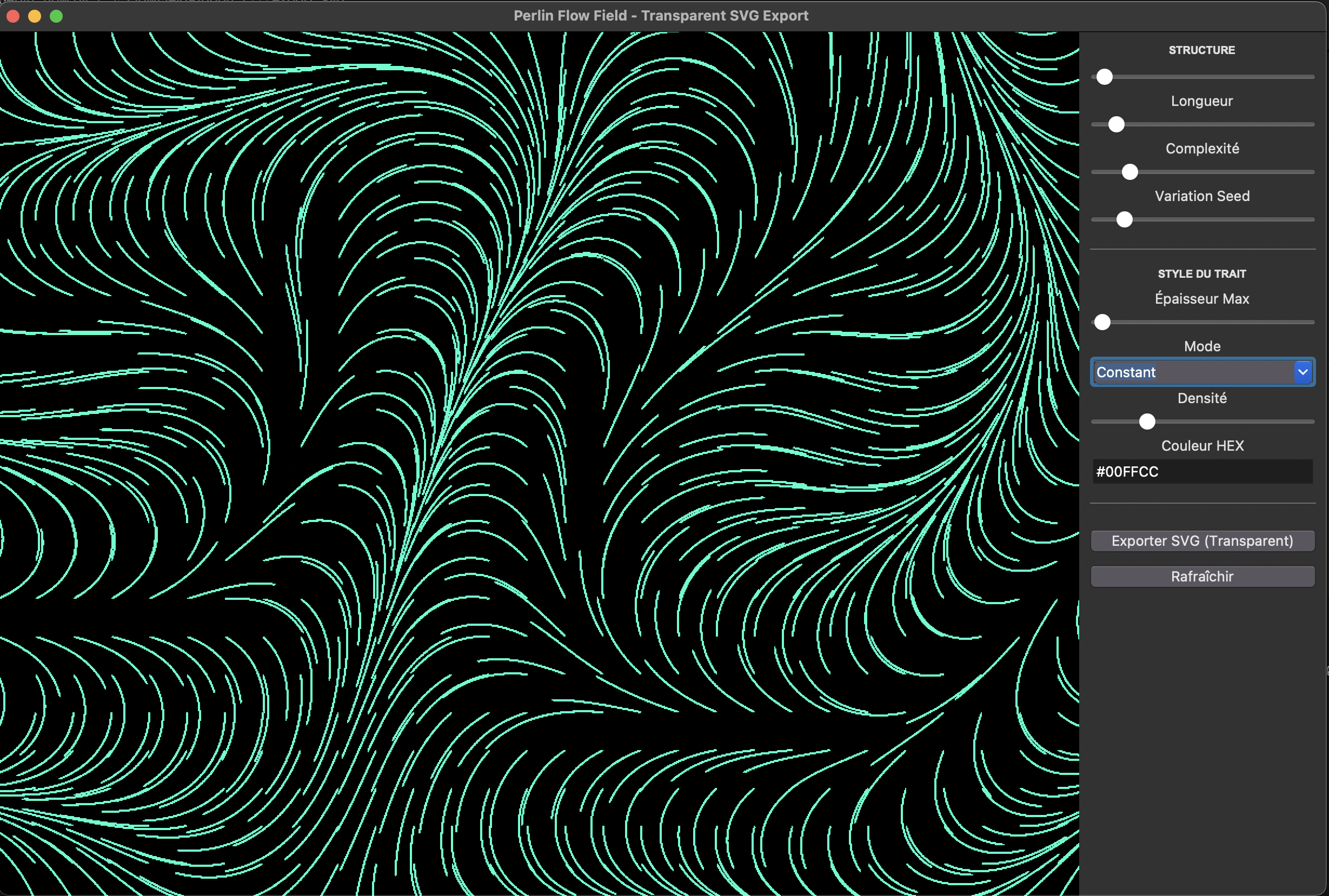
These illustrations are not merely decorative. They are generated using the Improved Perlin Noise implementation, utilizing the reference permutation vectors that ensure mathematical consistency. They serve as a constant reminder that at Ekio, our approach to product development is rooted in the deep understanding of the underlying patterns that govern physical systems.
References
- Perlin, K. (1985). An Image Synthesizer. ACM SIGGRAPH Computer Graphics.
- Perlin, K. (2002). Improving Noise. ACM Transactions on Graphics (TOG)