
Nature’s geometry: decoding the Voronoi Algorithm

If you have visited our homepage recently, you have likely noticed the complex, organic spherical structure floating in the background. It feels biological, yet mathematically precise. This shape wasn't sculpted by hand, polygon by polygon, in 3D software; it was grown through code.
In our previous exploration, Designing with Noise, we looked at how controlled randomness creates natural textures. Today, we delve into the architect of nature’s structures: The Voronoi Diagram.
The Voronoi algorithm is fundamentally a study of territory and proximity. It begins with a set of points, often called "seeds," scattered across a surface. The algorithm then divides the space so that every location on the map is assigned to the seed closest to it. Where these expanding territories meet, a boundary is formed.
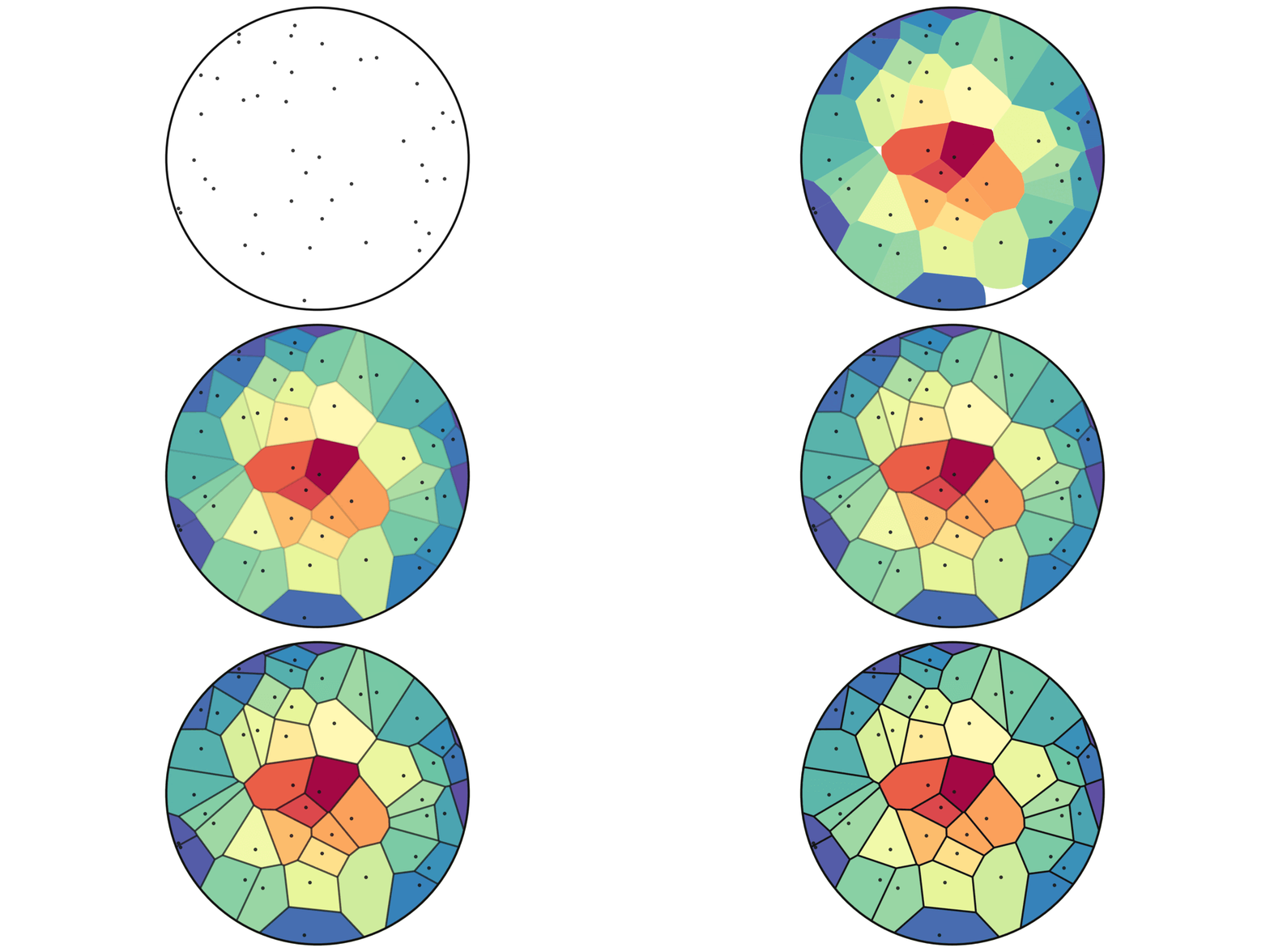
At Ekio, we leverage this algorithm to move beyond the rigid, "machine-made" feel of the standard Cartesian grid. By using Python to generate these patterns, our role shifts from traditional designers to system architects. Instead of drawing lines, we define the "seeds" and the environmental constraints, allowing the algorithm to reveal a complexity that mimics the growth of living tissue. This generative approach allows us to create structures that are not only visually striking but also mathematically optimized.
By mastering the legacy of Georgy Voronoi alongside the fluidity of Perlin Noise, we bridge the gap between the synthetic and the organic. The sphere on our homepage is a testament to this philosophy: a reminder that the most advanced technology shouldn't look like a machine, but like an extension of the natural world. When we code with the laws of nature, we create designs that feel less like software and more like life.
References
- Georges Voronoï, « Nouvelles applications des paramètres continus à la théorie des formes quadratiques. Premier mémoire. Sur quelques propriétés des formes quadratiques positives parfaites. », Journal für die Reine und Angewandte Mathematik, vol. 1908, no 133, 1908
- Georges Voronoï, « Nouvelles applications des paramètres continus à la théorie des formes quadratiques. Deuxième mémoire. Recherches sur les parallélloèdres primitifs. », Journal für die Reine und Angewandte Mathematik, vol. 1908, no 134, 1908